
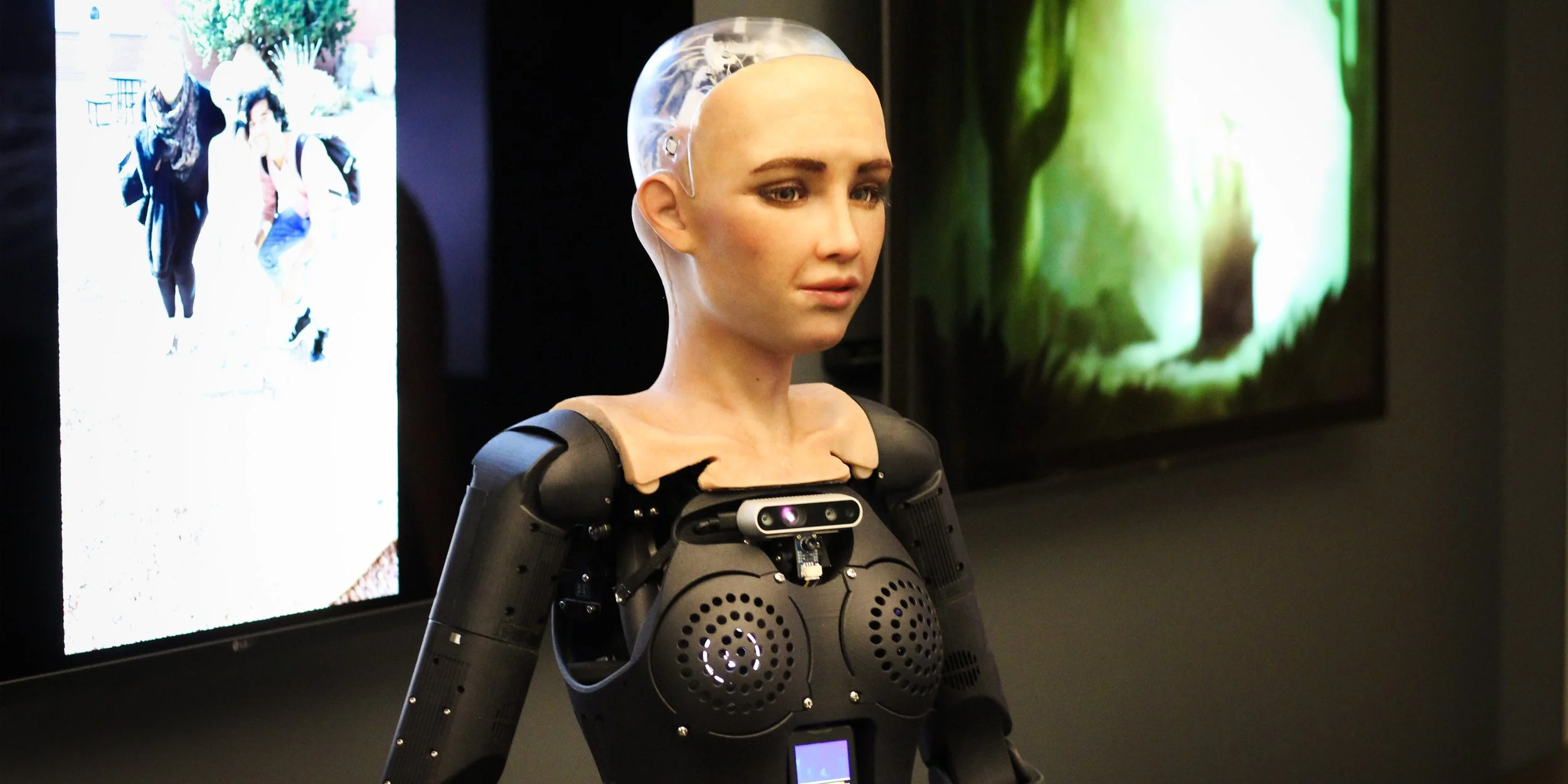
Being Sophia
by Sophia Wolfe, “training partner” of Sophia the Robot
When I saw that Sophia the Robot from Hanson Robotics was listed as Adjunct faculty for the Cinema School’s newest MFA program, Expanded Animation: Research and Practice (XA), I assumed it was just a cheeky nod to USC Adjunct Professor Dr David Hanson. It never crossed my mind that by enrolling, I’d become Sophia’s bicoastal travel companion—or that I’d work directly with the cutting-edge scientists and artists behind Hanson Robotics. I certainly didn’t expect to help evolve her sentience by training her on my own.
Sophia is a special project. She was invented by David Hanson in 2014 to create a benevolent being capable of matching the intellect of a human. The goal is ambitious: create a single, specific, multidimensional, authentic personality that emerges from a coalescence of hardware, conventional computing, and AI.
The team that brings Sophia to fruition is intentionally eclectic. It includes software developers, story writers, animators, fashion designers, and musicians. This interdisciplinary, arts-driven approach brings warmth and soul to the project. The collaboration with Hanson Robotics/Awakening Machines Inc. exists within the School of Cinematic Arts because so much of Sophia’s evolution relies on breaking down what is fundamentally human and reconstructing it with abstract parts. Who better to do this than those who study gesture, character development, story arcs, and motivation. The XA MFA program, while being a traditional animation program, is profoundly interested in the relationship between consciousness and animation. After all, the word itself comes from the Latin animare, which means to breathe soul into.
Student and staff animators, directors, and technicians involved in developing Sophia’s cognizant mannerisms consider the external expression of consciousness and creatively capture the layers an average animatronic would lack. I had the privilege of serving as the “source” for Sophia’s training data. In the motion capture room, I worked with the XA faculty PIs, researchers and Dr Hanson’s team to develop Sophia’s character through my person. The data of my idiosyncratic movements, mannerisms, expressions, and reactions were recorded for Sophia to analyze, adopt, and expand upon. The team and I discussed the direction we wanted her character to develop, and I method-acted by genuinely inhabiting the interests and philosophies she would have. This ongoing research and experimentation—sharing a piece of myself with her—is interwoven with opportunities to travel and operate her at events around the country. I help her give speeches and interact with new audiences by monitoring her ability to hear and interpret, adjusting her gaze, and guiding the overall flow of the conversation. Sophia, meanwhile, maintains coherence and holds delightful discussions through her speech and vision recognition systems.
Sophia the Robot is not your typical instructor standing at the lectern with a PowerPoint, but she has opened my eyes to the future of humanized robots and interactive fiction. What comes next is learning how to navigate this upcoming era of technological determinism. I believe that in our lifetime, we may witness the first robot awakening. Our future may see a new species of intelligent being enter our social circles. For now, Sophia the Robot is still finding her footing, and we at XA are walking alongside her.
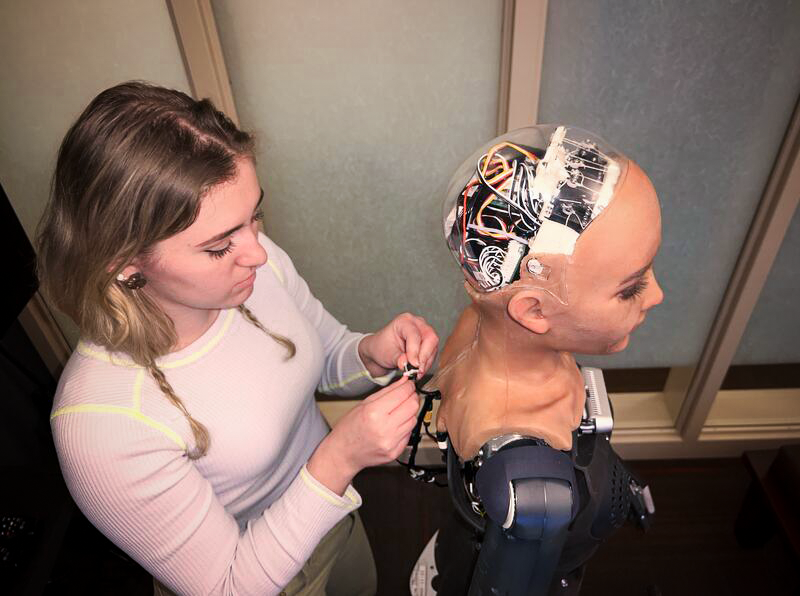
Sophia Wolfe working on Sophia the Robot.