

Al Gough (left) and Miles Millar (right). Photo courtesy of Gough and Millar.
From Film School to Wednesday
The Enduring Partnership of Al Gough and Miles Millar
by Lorena Sanchez
For more than 30 years, writing partners Al Gough and Miles Millar have navigated Hollywood’s unpredictable terrain together. From classmates in USC’s Peter Stark Producing Program to creators of one of streaming’s biggest global hits, their collaboration has endured industry upheavals, personal milestones, and creative challenges that might have broken a less resilient duo.
Gough and Millar met as classmates in 1994, instantly bonding over their shared love of 1980s blockbusters like Star Wars and Back to the Future. Though they grew up on opposite sides of the Atlantic, both were driven by the same dream: to make movies in Hollywood.
Millar, raised in London, longed to attend what he saw as the world’s best film school. After earning an English degree from Christ’s College, Cambridge, as well as rejections from every film school in the UK, he was training to be a teacher when his mother secretly got him a USC application. “Miraculously, I got in,” he says, adding “My mother, to her dying day, regretted that she ever made that call.”
Gough’s path was equally unlikely. Raised in a small Maryland town “where saying you wanted to make movies was like saying you were going to walk on the moon,” Gough spent years working in public relations in New York City. He was filling out an application for business school when he decided, “If I don’t try film school now, I’ll never do it.”
Their partnership formed naturally. In a writing class, each pitched an idea and wrote a first act. Millar’s script—about a cop and an orangutan titled Mango—won out. The two sold it while still in school for $400,000, during what Gough calls a “golden era” of Hollywood spec scripts.
“We called it our tuition for learning how to write,” Gough says. “You can sell a script, but it’s like winning the lottery—it doesn’t mean you have a career. So we used that money and met every day at Miles’ apartment to write.”
Both credit legendary producer Larry Turman, who was head of the Stark Program at the time, for launching their careers. “We wouldn’t have a career without him,” says Gough. “You’re always waiting for the first yes in Hollywood, and he was that person for both of us.”
The Stark program, Millar adds, offers a panoramic view of the industry. “It doesn’t have a singular focus. You learn about TV, film, producing, the legal side; everthing.” Their classmates became lifelong peers. “We’ve come up with them,” Millar says. “We’re competitive, but incredibly loyal to each other.”
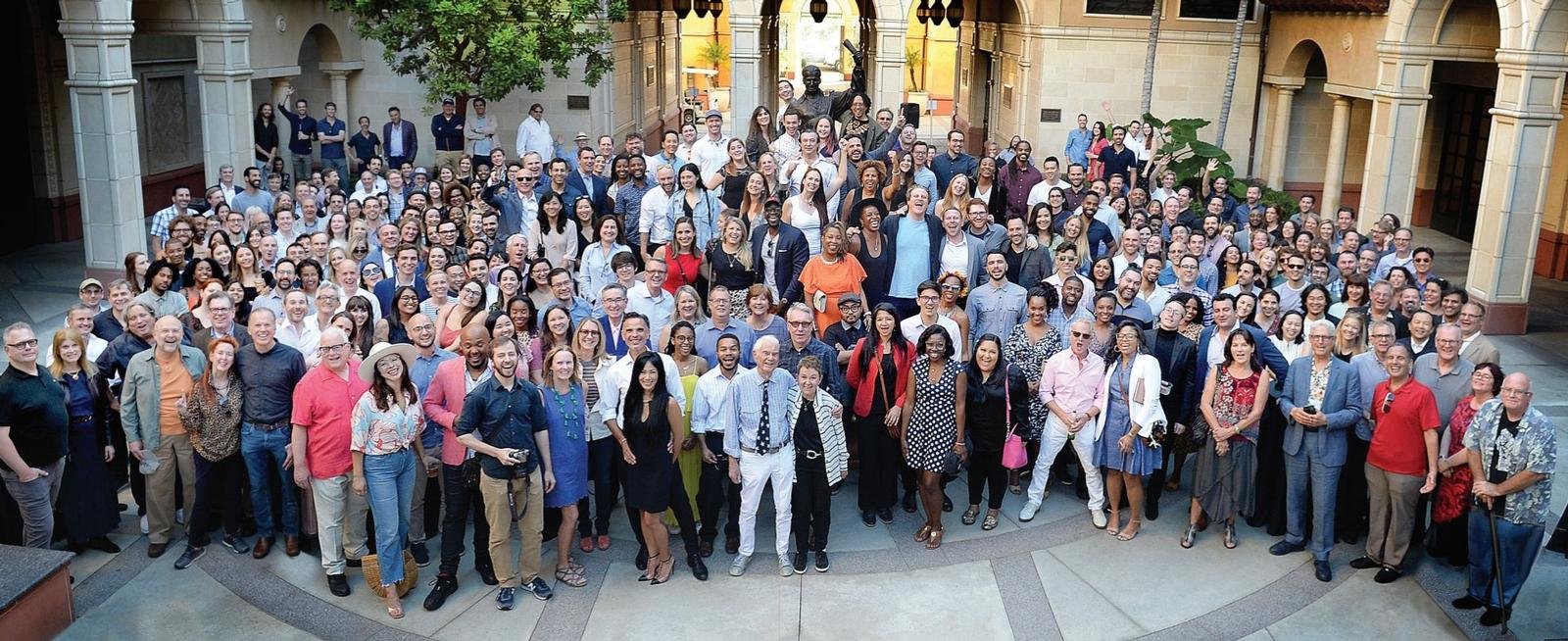
Peter Stark Alumni celebrating 40 years of the program with Larry Turman and Dean Daley in 2020.
Adapting to an Evolving Hollywood
Hollywood tried to pigeonhole them, first as “buddy comedy” writers when they wrote the Eddie Murphy/Robert DeNiro buddy cop spoof Showtime and the Jackie Chan/Owen Wilson breakout Shanghai Noon. Then as superhero showrunners after they created the Superman prequel Smallville that ran on television for ten seasons.
Their shift to television came at a critical time. “Back then; film and TV were church and state,” says Millar. “Movie people looked down on TV.” But starting as feature writers helped them straddle both worlds. “The great thing about TV is you learn how to make something. It’s hands-on.”
Millar and Gough kept reinventing themselves, building a career that has spanned several genres and platforms. Their evolution now includes hits in today’s three major forms of screening entertainment— theatrical films (The Mummy: Tomb of the Dragon Emperor, Beetlejuice Beetlejuice); television (Smallville, Into the Badlands), and streaming (Wednesday).
Millar also sees a through line in their work: “There’s always an element of escapism, humor, and heroism—characters going through crises who emerge uplifted. You should feel you’ve escaped and come out better for it.”
A Creative Marriage
After decades together, they’ve honed a division of labor that keeps them balanced. Gough handles network executives, budgets, and business affairs; Millar oversees production, design, and editing.
“We cover each other’s blind spots,” says Gough. “No one can do this job alone. Even solo showrunners rely on others—it’s never a one-person job.”
They trade off writing drafts, which they consider their core responsibility. “Writing is the most important part of being a showrunner,” says Millar. “We take that very seriously.”
For nearly 20 years, they wrote in the same room—Gough on legal pads, Millar at the keyboard. “Eventually, my handwriting became illegible, even to me,” Gough laughs. Distance, global shoots, and the pandemic changed that. “We used to write side by side,” says Millar. “Then we were in different countries. It evolved, but it still works.”
“Show business can be an emotional knife fight,” Gough reflects. “It’s nice to have someone to go through it with.”
“It really is like a marriage,” says Millar. “Personalities evolve, goals shift, and the business is unpredictable. Doing it together helps you survive the extremes—the highs and the lows.”
They’ve grown in sync both professionally and personally. “We got married within a couple years of each other, had kids around the same time,” says Gough. “We were just in step—serendipity, really.”
Timing also helped financially. “When we started, you could afford to be partners,” Gough says. “Now it’s tougher economically because you split everything. We joke that we know a lot of ‘divorced’ writing teams from the ’80s and ’90s.” Thirty years later, they’re still together—by choice.

Jenna Ortega as Wednesday Addams in Netflix’s Wednesday.
The Wednesday Phenomenon
Their latest hit, Wednesday, is a culmination of everything they have learned in creating hit television. “With Wednesday, we now have a 360-degree view of how to make a show,” Millar notes.
The fact that it has succeeded beyond all expectations is icing on the cake. “Nobody expected it to become what it did,” says Gough. “We were proud of it, but the scale of its success was unbelievable.”
They thought it might appeal mostly to teens. Instead, it resonated across ages and cultures. Millar credits Wednesday herself: "She's the ultimate outsider, and I think it speaks to the idea that everyone considers themselves an outsider. Everyone's sort of uncomfortable in their skin, and they see something in her that resonates." There's also something aspirational about her fearlessness and her analog existence in a digital world. "We're all addicted to phones and technology, and she is not at all. So I think that's something that people dream of—a strength of character, that you could do that."
Their favorite feedback came from a USC student: “Most people your age write things that are cringey, but this wasn’t cringe,” Gough recalls, laughing. “We want that on a T-shirt.”
Advice for the Next Generation of Starkies
When asked what they'd tell current USC students, their answer is immediate and emphatic. "You don't wait," Millar says. "You have to hustle... We could have a success, but it's always about the next project. And we are constantly hustling and thinking of new ideas."
He continues: "There's a Willie Loman element to any aspect of the business. You gotta get out there, you gotta sell your ideas, you gotta have passion, you gotta believe in them. And you will them into happening... that takes incredible willpower, resilience, persistence."
Despite the challenges facing Hollywood in every era, Millar remains optimistic: "I still believe, fundamentally, that if you have a great script, or a great showreel, or a great anything, it'll be discovered. And people are so hungry for something that is original... there's still huge potential, even though every era is like, it's the end of Hollywood, but it never is."
Looking Forward, Not Back
Perhaps the secret to their longevity is that ability to stay focused on what’s next. “We never look in the rearview,” says Millar. “Sometimes people mention a project, and I’ve completely forgotten it. The rearview doesn’t exist. We’re always moving forward. What’s next—that’s what matters,” he adds. “What will spark us creatively, what will excite us.”
Currently immersed in Wednesday, they’re eager to collaborate with more filmmakers they admire. “Working with Tim Burton has been amazing,” says Millar. “We’d love to do that again—with him or others we respect.”
For now, they remain what they’ve always been: two film-school friends who bonded over Star Wars and Spielberg, learned to hustle at USC, and discovered that the best way to survive Hollywood is together.
“The USC cinema school calling card is a great one,” says Gough. “It definitely helped—100 percent.”