
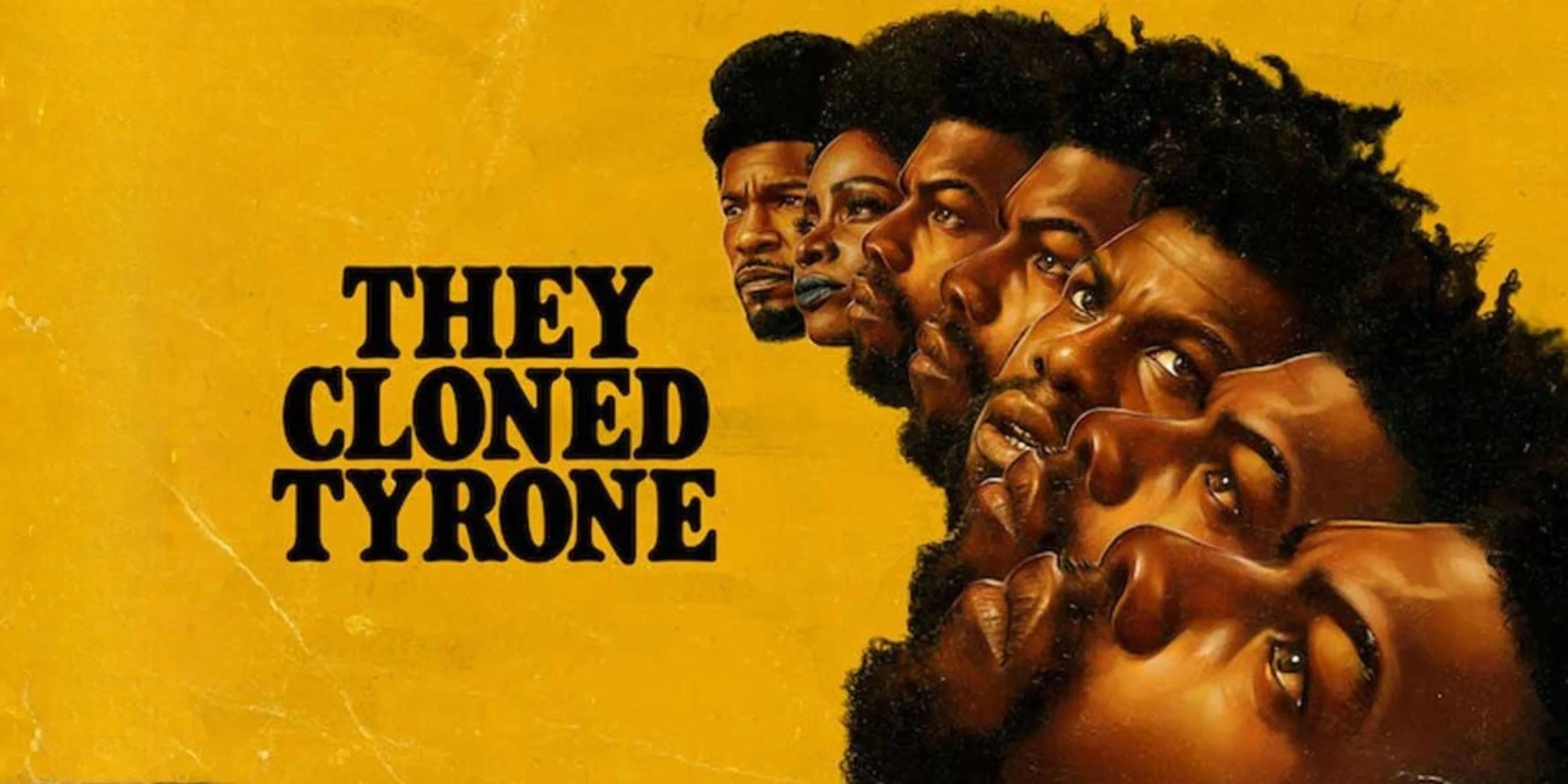
From Gym Partners to Writing Partners: Juel Taylor and Tony Rettenmaier on Structure, Collaboration, and Breaking In
by Ryan Gilmour
Juel Taylor (MFA, Production 2015) and Tony Rettenmaier (MFA, Production 2015) have come a long way since their time at SCA. As filmmakers, they’re known for their hit Netflix comedy They Cloned Tyrone and have recently been hired for the big-budget adaptation of Mattel’s Hot Wheels. InMotion asked them to reflect on their process, the lessons they learned at USC, and why the gym is a good place to meet a lifelong collaborator.
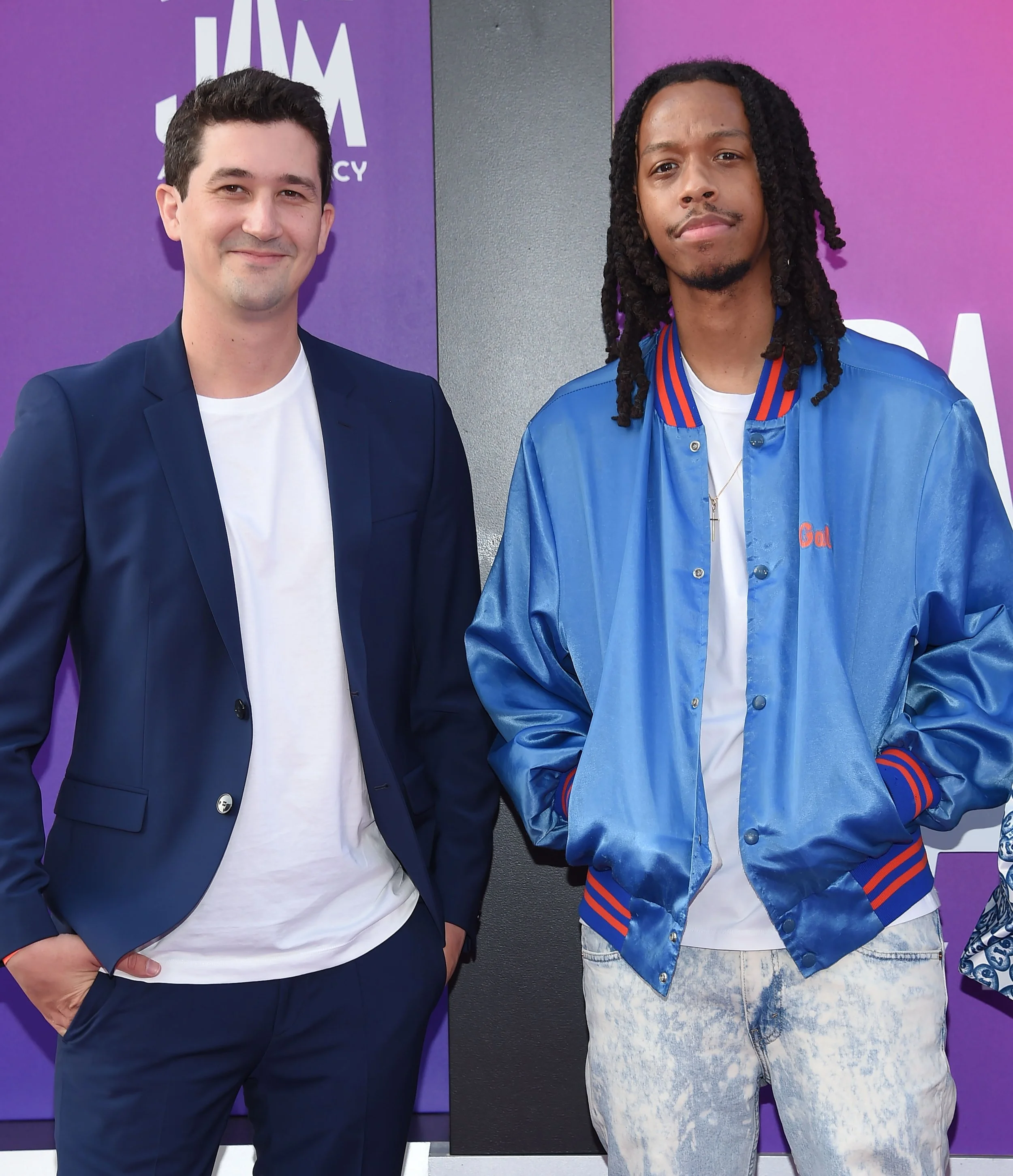
Writing partners Tony Rettenmaier (left) and Juel Taylor (right).
InMotion: Let’s start with how you met. What was the moment you met, and when was the first time you worked together?
Juel Taylor: I'm pretty sure we met at 507 orientation. We were both in different 507 and 508 sections. We met for real at the gym. We happened to both have free blocks to hit the gym. I think the only writing class we had together was Irving Belateche's script analysis class, which was an amazing class that we still refer to to this day.
Tony Rettenmaier: It's ironic that we met at the gym. I say ironic because we are both pretty wiry dudes. Between sets, we would talk about the stories we were working on for class, and that eventually evolved to hanging out and chopping it up about scripts in general. The gym thing never panned out, but we're still doing the writing thing all these years later.
IM: Do you have a favorite project you worked together on at USC?
JT: We never really worked together on a class project, so I'm gonna go with an extracurricular short film that me and another classmate of ours—shout-out to Joel Marsh, who's currently on Hacks—wrote and directed during my 508 semester. It was super ambitious, and we were all over the place "borrowing" exotic locations in the desert near Baker and out in Lancaster. We had a crew of maybe five. Tony was one of those five.
TR: Juel helped me in my motion capture class when I needed someone to put on the capture suit and animate a dancing robot. So he says we never worked together on a class project, but that's inaccurate. He was a dancing robot.
IM: When we have alumni visit, we like to ask about lessons learned at SCA. Who is a professor that changed the way you work as artists, and what’s the lesson?
TR: I think for both of us, the answer to this is going to be Irving Belateche. I had him for the intro writing class, and then we both had him for his screenplay structure class, in which he explains the eight-sequence method of writing. We follow the lessons we learned in that class to this day and are continually repeating aphorisms that Irving said, like "put your cool shit first and then figure out more cool shit later."
Professor Belateche had a great way of breaking down the mysticism of writing and approaching it like a craft. I honestly think that a big reason we have gotten most of the writing gigs we have is because we could communicate the structure lessons we learned in Irving's class to studio execs and producers. We always encourage any students we meet to take classes taught by Irving. We had a lot of great teachers at USC, but Irving is definitely the one that affected us in the most day-to-day sense.
JT: Ditto. Irving's class was definitely the one that we draw on the most. I think we've just internalized a lot of that, and when you're working in a studio system, having a good handle on structure is one of the things that'll keep you working. I also want to shout out my other writing professors because I got lucky with my writing classes. Harold Apter's 505 was great. Nevin Schreiner's 533A really got me to loosen up as a writer and trust my instincts more. And Siavash Farahani's 533B made me practically apply the structural stuff I learned in Irv's class. Two other professors I'd be remiss not to shout out: James Savoca and Barnet Kellman. Savoca was the only directing class I actually took, and I had a great time in his class, and Barnet let me audit his class when I couldn't get in and basically treated me like I was in the class (even got me a little job after!).
IM: What advice do you have for the next generation of Trojans who are currently in school?
JT: I think there's an appetite with audiences for low-budget and mid-budget original stories that studios are starting to pick up on. We're already seeing Neon and MUBI join the A24 party with financially successful lower-budget movies. Some of which are super niche but still made money. And it seems like with the success of Sinners and Weapons and One of Them Days and F1, these original movies are the ones winning for the studios. So I think there could be a bit more room for original stuff to find its place back in theaters with more regularity. At least I hope so.
TR: Experiment more with your films during school. While you're a student, there's this pressure to create a body of work that will act as your portfolio when you get out of school. In practice, I don't know too many of my classmates that have actually gotten work or started their careers because of a short film they made early in the program. That's not a knock on the program but just a reality of how people break into the industry. So with that in mind, I'd say experiment more with your films as opposed to trying to make them perfect or sellable. It is useful to leave school with at least one well-produced project that showcases what you can do, but for all of the rest of your projects, don't be afraid to do weird shit. This will stretch you creatively and help you find your style, which you may not ever develop if you play it safe all the time. I wish I had done more of this.
Practically, I'd say "quantity over quality," at least starting out. Juel and I were in the production program, but we got our foot in the door through writing, so I can only really speak to that as a path. And what we found was useful along that path was to have many sample scripts in many different genres. Often we hear about students or classmates that have been working on one passion project for years. It's great to have something like this, but what we've found is that having three or four complete scripts in different genres that are all pretty good is better than having just one great script. Not only will this give you a variety of samples to fit the attitude of whoever you are sending them to, but it will also stretch your craft. Writing is like going to the gym—the more you do it, the better you'll become.
And on the extreme end of the practical spectrum, I'd say try to leave school with a feature film script and a proof-of-concept film for that feature. It's hard to convince someone (an agent, an exec, a producer) to read a 120-page script from an unproven artist. Paralleling that, short films don't have a ton of value in the real world (no one is "buying" short films—it's a feature and TV show game). But if you combine the two, it becomes a different story.
Someone (again, an agent, exec, or producer) might not want to spend two hours reading an unknown's script, but they may be convinced to watch an intriguing five-minute film. Again, paralleling that, you don't want to be in a situation where someone loves your short film but you don't have anything else ready at the moment to develop with them. Using your time at USC, when you're surrounded by collaborators, to write a producible feature and then using the school's resources to produce a proof of concept for that feature (in either the thesis film class or any high-level production class during your last year there) is, in my opinion, the way to give yourself the best odds of making something quickly coming out of school. This is obviously not a guarantee, but it's exactly what I wish I had done.