
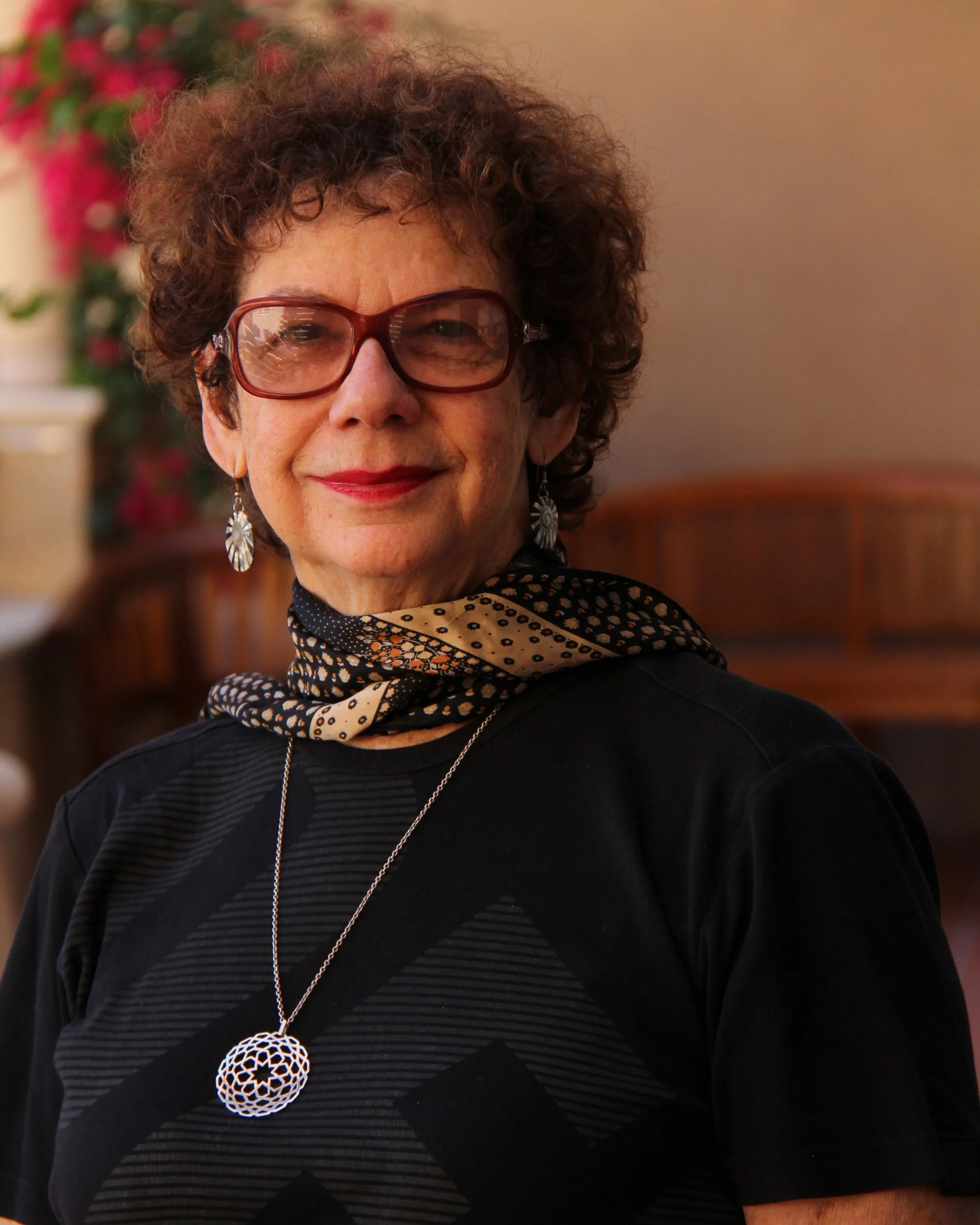
Cinema & Media Studies (CAMS) Remembers Marsha Kinder
Tributes pour in for the beloved professor of film and media studies, from colleagues who worked with, or were mentored by her at SCA
Marsha Kinder was a professor’s professor, the kind of scholar that other scholars were eager to speak with, collaborate with, and saw as a beacon of knowledge and advice about the field. She joined the School of Cinematic Arts (SCA) faculty in 1980 and helped shape the division into one of the world’s leading programs on the history and impact of cinematic media. She had previously founded in the film and media studies program at Occidental College in Los Angeles.
While at USC, Kinder produced groundbreaking interdisciplinary work at SCA, the Annenberg School for Communication and Journalism and in the Gender Studies program at the Dornsife College of Letters, Arts and Sciences. She shared her expertise with cyberculture, digital media, and sexuality and nationality with anyone who needed insight and clarity on the role media played in these realms, whether they were students of fellow pioneers. Beginning in 1997, she was the director of The Labyrinth Project, producing a series of award-winning projects that have been exhibited at museums, conferences, and festivals around the world. She retired from USC in 2012, earning emeritus status. During her tenure at USC she received the USC Associates Award for Creativity in Scholarship, and in was named a University Professor for her innovative interdisciplinary research, a distinction given to scholars of acclaimed interdisciplinary work.
Holly Willis
Professor + Chair, Media Arts + Practice Division,
USC School of Cinematic Arts
My experience with Marsha Kinder began on the east side of 309, three seats down from the head of the table where Marsha sat introducing a group of us to Althusser, Foucault, and Bakhtin. She came to class with a tower of books and a stack of notes, and an extremely high level of piercing expectation, creating an atmosphere of total terror. I didn’t really know how to be a graduate student, but I felt like each week was a trial and a revelation. Desire! Power! Discourse! After our first paper, Marsha recognized my passion for theory and demanded more – more thinking, more speaking, more writing. It was thrilling to be seen, and I could sense a kind of transformation. Another semester, in a class on feminist film and video, Marsha proposed that I interview a filmmaker and craft a contribution to Film Quarterly. It was my first real publication, and again, I felt like she’d opened a door to an entirely new way of being in the world – talking to artists, contextualizing their work, writing for an audience. Later, visiting my clumsy efforts crafting small exhibitions and screenings, Marsha dubbed me a “curator” and then invited me to collaborate on Interactive Frictions, a showcase of interactive artworks. A group of us worked together on the very ambitious exhibition exploring interactivity, which turned out to be both way ahead of its time and formative for the LA media arts community. Again, I sensed a kind of radical, internal shift as I stepped into an identity that Marsha had opened up and invited me to enter. And that’s what Marsha did for her students: like a magician, she was able to conjure new identities by sensing potential, pointing us in new directions, and then engaging us as partners and collaborators. Looking back now, I’m frankly startled to realize how much of my adult life has been shaped by these seemingly minor but prescient acts of generous naming. Thank you, Marsha.
Mark Jonathan Harris
Emeritus Distinguished Professor, SCA
I had the great fortune to collaborate with Marsha Kinder on three major projects at USC. Marsha was the rare professor who combined theory and practice and openly sought collaborators from other disciplines. I was delighted to join her in writing and producing Runaways, an interactive video game that explored issues of gender and ethnic identity.
Our second project was the Global Exchange Workshop, which grew out of our attendance at a documentary film festival at the Communications University of China in 2004. We were so impressed by the energy of the students and their embrace of technology that we initiated a cross-cultural collaboration between our universities that survived both our retirements.
Our most important partnership was Interacting with Autism, a video-based website built to communicate the best evidence-based treatments for autism. We expanded the scope of the project, interviewed the country’s leading autism experts, and over five years produced 32 short videos, subtitled in both Spanish and Mandarin. I remember one remarkable interview Marsha conducted with Temple Grandin, who replied to one of her theoretical questions, “Oh, that’s too top-down. I can’t think that way. You have to be more concrete.” Marsha quickly adapted and rephrased her question. That brief exchange epitomized Marsha. She was as comfortable discussing Derrida and Lacan as video games, as adept at making films as she was analyzing them, and always willing to reexamine her ideas. Her intellectual brilliance, insatiable curiosity, openness, and playfulness made her a remarkable collaborator. She’s the only person I’ve worked with whose notes on a lunch meeting would be on my computer within an hour of my return to the office. She set a standard I’m still trying to live up to.
William Whittington PhD
Assistant Chair of Cinema and Media Studies (Retired), SCA
Marsha Kinder listened. Our initial meeting was during the first week of her Narrative Theory Seminar in the mid-1990s. I was both a new PhD student and a full-time archivist at the USC/Warner Bros. Archives, and given the constraints on my time, I proposed that I start work on the final paper for the class immediately. She was thrilled. We discussed my background as a filmmaker, talked about archives and primary research, found that we shared a passion for experimental novels and new technology, but most important, we both agreed that the study of film sound was underrepresented. So, together we pursued a means to change that. In subsequent meetings, Marsha encouraged my work on sound design suggesting new books and articles, and when I speculated the line of argument could be held together by genre, specifically science fiction case studies, she said that a dissertation with those elements would be “groundbreaking.”
As my eventual dissertation chair, I learned that what drove Marsha as a scholar was her uninhibited intellectual curiosity as well as her commitment to her students. She wanted each one of us to not only contribute to the field, but to transform it—not just once, but throughout our entire careers. She once told me that she attributed her success to the fact that she reinvented herself every decade. When I quipped, “Just like Madonna.” She laughed and agreed.
Since that first meeting, we both reinvented ourselves many times over the years, but I was fortunate that at pivotal moments, Marsha was always there for me. She even brought me back to USC as the Assistant Chair of Critical Studies, after I’d built a life in publishing.
One of the standout initiatives from our renewed work together at USC was the Postdoctoral Fellow Program in Critical Studies, which was specifically designed to support transformative work by recent PhD students. For these new positions, we linked teaching of senior seminars with editorial work on the division’s journal Spectator. The acknowledgement ledger on every issue from that time forward listed Marsha Kinder as Founding Editor, while I filled the role of Managing Editor, and a Postdoc the Special Issue Editor. I have since retired (to reinvent my life anew), but I will always remember Marsha for her kindness, generosity and friendship. Like many, I will miss her voice, but I will be forever grateful for her ability to listen.
Tara McPherson
Professor, Cinema & Media Studies Division, SCA
In speaking with various friends and colleagues about Marsha Kinder since her passing, two words kept peppering our conversations: generous and fierce. The uniqueness of Marsha can be held in the continuum between those two very different adjectives, for she was at once both powerful and giving. Her intelligence was palpable and expansive, and she shaped fields ranging from Spanish cinema to children’s media to interactive design. She served as an encouraging mentor to decades of students, and the impact of her thinking and her care shapes universities across the globe.
I met Marsha when I joined USC as a young professor thirty years ago. I was at first intimidated by her, but I came to value her insights and her honesty and learned a great deal from her. We worked together on a large conference on interactive narrative in 1999 and co-edited a book together, but some of what I carry with me from Marsha is less tangible. She was committed to feminist ideas, having helped forge a path for women in the university. When I was about to chair Cinema and Media Studies while still fairly young, she offered straightforward advice about the challenges for women in leadership roles.
She was also very fully herself, perhaps more than anyone I have known. She didn’t suffer fools and did not hesitate to tell you what she really thought (even if you were a Provost or a President.) Her honesty could sometimes be hard to hear, but it was also very valuable. Today, the values of higher education are much under threat. We will need to channel the wisdom and the fierceness of Marsha as we fight against censorship and for democratic ideals.
Steve Anderson
Professor, UCLA
It's difficult to imagine the trajectory my professional life might have taken if not for Marsha's presence at USC in the late 90s and early 2000s. I had been admitted by mistake to an interdisciplinary program (FLIC) that was no longer supposed to be taking new PhD students and I felt pretty sure I would be found out sooner or later. I also knew that one day someone would realize I only had an MFA from CalArts instead of the MA that seemed to have better prepared all of my peers for graduate study. But Marsha somehow regarded all of this as a feature, not a bug. She put me to work on Dreamwaves, an interactive gallery for dream-related art and a portal to access her archive of the journal Dreamworks that she co-edited in the 1980s (long before the movie studio absconded with the name). It was the first of Marsha's Labyrinth projects to exist on the web rather than on CD or DVD ROM, and it used Flash, which was transforming the way we thought about media and interactivity online, but still driven by the recombinant possibilities of the database. I had never thought of myself as a designer, but Marsha treated me like one, and letting her down was really not an option. Others are better positioned to speak of Marsha's intellectual and creative vision for Labyrinth, but for me it marked an invitation to take my first steps, irreversibly, into a garden of forking paths that has shaped everything since.
Priscilla Peña Ovalle
Associate Professor, Cinema Studies, University of Oregon
Marsha Kinder was fierce. Brilliant. Fiercely brilliant. I had the honor of working with her in two capacities: she was my dissertation advisor and my boss at the Labyrinth Project. In both realms, she clearly operated on a different level. Her intellect and wit were palpable, powerful. I was just a little bit scared of her—a healthy fear that drew me into her orbit, kept me honest and hard-working. I did not want to disappoint Marsha Kinder.
Marsha modeled a different way of being, inspiring those around her to do their best work. She was smart and hard-working, of course. But she was also curious and sure in equal measure. Her sly smile and sparkling eyes made intellectual pursuit seem fun, even a little naughty. That impish desire to learn and share knowledge—about nearly anything—left an indelible mark.
As I grieve the loss of this amazing woman, two things loom most large in my memory. First, she took up space in the best possible ways. I admired her ability to occupy any seminar room, modeling a confident but not oppressive sense of self. With the Labyrinth Project, she made history and theory explode off the page, literally filling museums and galleries across the globe with image and sound. But Marsha’s generosity leaves the deepest impression. She cultivated collaborative community and brought so many of us into the fold of creative, interactive scholarship. Her website (marshakinder.com) is humbling, not just because of the sheer quantity of work documented, but because of the kind, careful ways that she recognizes and reflects on the many people that shared her intellectual journey. Her legacy continues to ripple, impacting generations to come. Thank you, Marsha.
Bhaskar Sarkar
Professor, Film and Media Studies
University of California-Santa Barbara
I first met Marsha Kinder in the late 1980s, when I was still an Economics MA-PhD student at USC. Put off by the required coursework, with rather tenuous connections to real life markets, I had applied to the Critical Studies graduate program in the then School of Cinema-Television. Marsha contacted me to say that my lack of undergraduate training in any cognate humanities or arts field had got in the way of my admission to the program. She met with me and convinced me to take her grad level “Introduction to Film Theory” seminar for credit. Her point was that not all cinephiles enjoyed theory and analysis, and I had to be certain that film theory, history, and criticism was the right discipline for me before I made the big switch. And so, I went into CNTV 500 without knowing that this was the most anxiety-inducing seminar in the program. Or that for most of my peers, Marsha was a stern figure who elicited as much fear as reverence. To me, she was the one who had gone out of her way to accommodate me; eventually, she would write me a recommendation letter based on my performance in the gateway seminar that would get me into the program with funding. When directors of comparable graduate programs in Chicago, Los Angeles, and New York worried about my level of commitment, and thought that admitting me would be a risky proposition, Marsha took an affirmative view of my obsession with cinema (undoubtedly a shared passion, for over the next decade, I was more likely to run into her than any of my classmates at screenings all over Los Angeles) as well as my academic potential, warmly welcomed me into the program, and as my advisor made sure that I would be successful. It was upon her insistence that I applied for the position that I hold to this day, at a point when I had barely started writing my dissertation and did not think I was ready for the job market. Of course, Marsha knew better.
The last time I met Marsha was at her place, exactly a year ago; we spent a lovely afternoon having lunch, talking animatedly about food, politics, higher education and, of course, cinema in all its expanded forms. It was difficult to see her in a wheelchair, for I remembered the days when, as she walked down the department corridors, even her footsteps seemed to have intention. But it is her smile–genial, affectionate, and even somewhat indulgent–that her students, who have been fortunate enough to be close to her, will remember her by. It is a memory that will continue to warm and sustain me for the rest of my life.
For more on Professor Kinder’s life and work, visit marshakinder.com