

Designing for Cross-Sector Impact: Celebrating the Legacy of USC’s Creative Media & Behavioral Health Center
by Malini Adkins
Led by Marientina Gotsis, the Creative Media & Behavioral Health Center (CM&BHC) at USC's Interactive Media & Games Division (IMGD) was born out of the USC Games for Health initiative, which launched in 2007 and gained sponsorship by the Robert Wood Johnson Foundation in 2008. The goal from the start has been to create a space where students can explore interactive entertainment at the intersection of behavioral science, medicine, and public health. The vision is to move beyond traditional game design and create tools that make a difference in communities, organizations, and industries around the world.
CM&BHC also aims to raise public awareness of mental health and behavioral science while giving students the tools to create meaningful change. While USC Games focuses on game design and development, the health emphasis extends its reach into medicine, rehabilitation, aerospace, neurotechnology, and education.
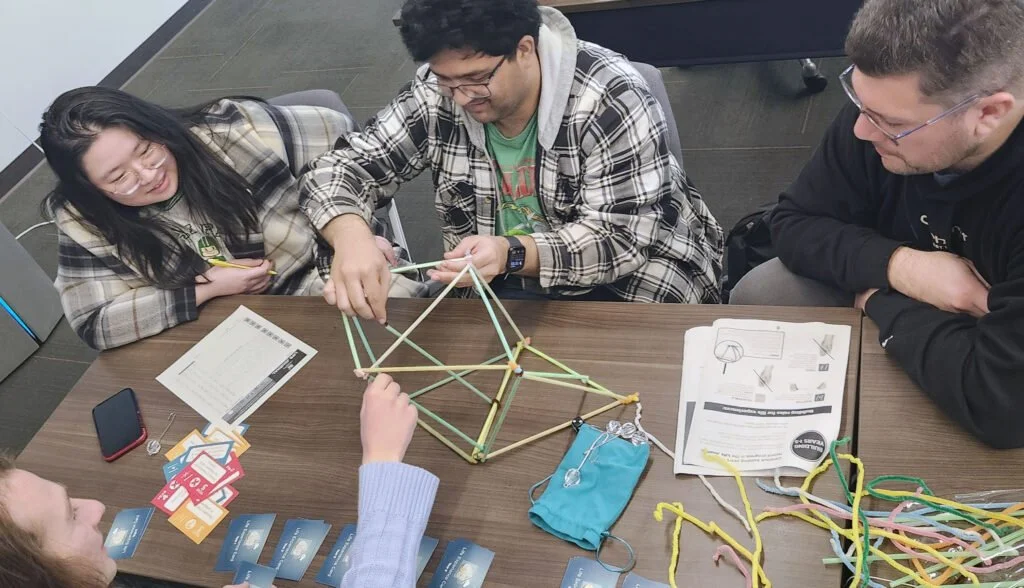
Students in USC Games’ CTIN 503 course explore The Brain Architecture Game. Courtesy of Professor Marientina Gotsis.
By working in an interdisciplinary environment, BFA, MA, MS, and MFA students, along with many students and volunteers of every rank and discipline, gain skills they carry far beyond their time at CM&BHC. This aligns with Gotsis' educational and professional philosophy. As the lab's director and co-founder, she brings her interdisciplinary background in arts, design, and engineering to developing interactive entertainment applications for health, happiness, and rehabilitation, and encourages her students to bring their own perspectives to the social impact projects they work on together. "All the students coming through the center are designers and design researchers who are interested in social impact," Gotsis says. "The impact manifests via design choices. Whether something is used once or daily, it affects people."
In addition to Immersive Legacy (VR) memorials (see story above), some of the center's current projects include games focused on understanding patient-centered research and games for occupational therapists and their patients to discuss burn injury rehabilitation.
Many of the center's games are created and developed by students. Recent examples include Val(iant), a single-player browser game about sexual health; Hedge Hug, a game about social anxiety; Alma, in which the player serves as a pediatric nurse; and Here, My Voice, which helps hard-of-hearing people gain confidence in their voice.
For more about the Creative Media & Behavioral Health Center, visit https://cmbhc.usc.edu/